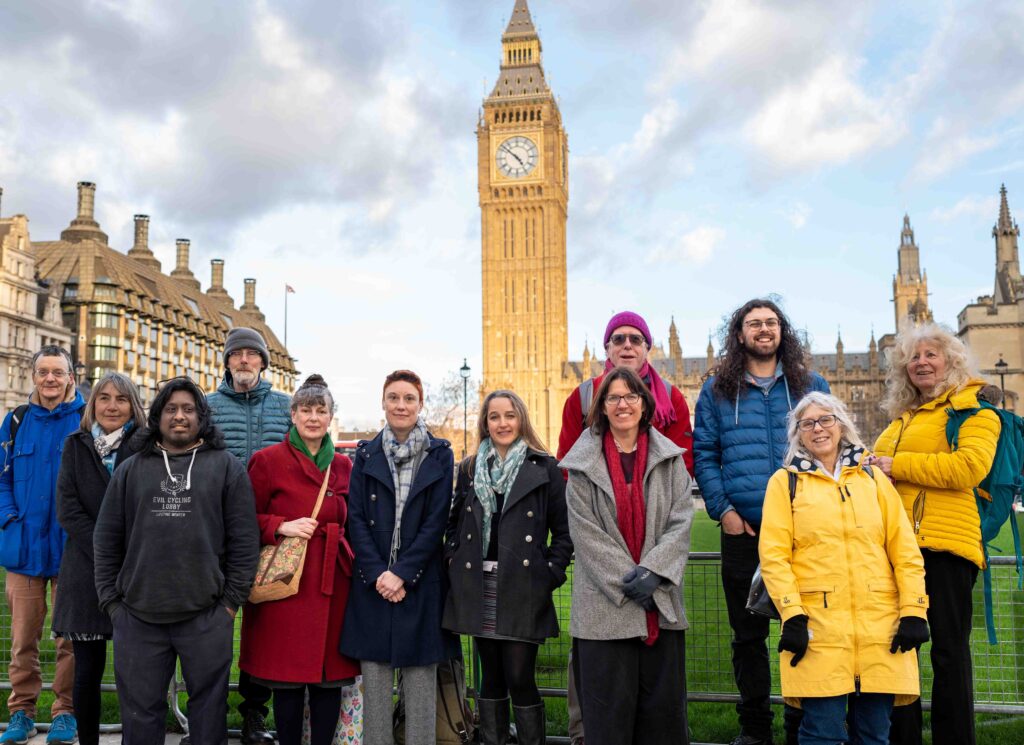
 Two campaigners from Norwich For Warm Homes attended a parliamentary reception on Monday 26th February in Westminster to launch a new report led by Professor Sir Michael Marmot’s Institute of Health Equity (IHE) at University College London (UCL), on behalf of Friends of the Earth;
‘Left out in the cold: the hidden health costs of Britain’s cold homes’.Produced as a follow-up to a seminal 2011 report, the new analysis finds a staggering 9.6 million UK households are currently living in poorly insulated homes with incomes below the minimum level at which an acceptable standard of living is affordable – meaning that finding enough money to pay for decent housing, enough heating and the basic essentials of life will be out of reach for most – at stark detriment to their health and wellbeing.
In Norwich itself, there are 18 fuel poverty hotspots and there are 49,829 homes with poor insulation – those with an energy performance rating of D or lower – making them inefficient and expensive to heat.
The report comes just weeks after the Labour Party back-pedalled on its spending commitment to tackle the cold homes crisis if voted in at the next election. The current government’s spending pledge falls even further short of the urgent investment needed to address the scale of the problem.
Professor Sir Michael Marmot, director of the UCL Institute of Health Equity, said:
That there are millions, in a rich country like ours, living in cold homes is a national disgrace.
Cold homes are a public health hazard: those living in them have much higher risk of developing poor physical and mental health and this is adding burden onto an already overstretched NHS, and contributing to poor productivity.
We need urgent action to address poverty, the cost of fuel and to insulate the homes of the poorest, not just because the government has a moral duty to look after the health of its population, but also, frankly, because it makes economic sense too.”According to the latest research, adults that experience prolonged cold temperatures at home double their risk of developing new mental health conditions, while the risk of exacerbating existing mental health issues triples.
Physical discomfort from the cold, financial stress, social isolation and loneliness are all thought to contribute to declining mental health.At least one in five people out of work because of ill health are living in cold homes. The impacts on children are also significant. It’s estimated that 1.7 million school days are missed across Europe each year due to illnesses associated with damp and mould, with rates among UK children 80% higher than the European average, at detriment to their long-term prospects and educational outcomes.
Sarah Eglington, from Norwich For Warm Homes said;
The UK has the oldest and least efficient housing stock in Europe. Since 2013, installation rates of energy saving measures and insulation have plummeted by 90%. We need an urgent commitment from all political parties for a nationwide programme of insulation.
This hard-hitting report should spur all political parties into action as we head towards the general election. We need to see transformative levels of investment and action to stem the huge social and economic costs of cold homes and ensure our internationally agreed climate targets are met.
Investment to upgrade UK homes would go some way to alleviating the high number of people experiencing cold-related hardship, while also saving the economy billions each year in avoided health, climate, and economic productivity costs.This investment is also essential for meeting legally-binding carbon reduction targets and international climate commitments.
Researchers at The UCL Institute of Health Equity have calculated that a national scheme to insulate low-income UK homes to a suitable standard (Energy Performance Certificate grade C), would cost in the region of £74.5bn.
Using regulations to ensure landlords upgrade heat-leaking homes to a suitable standard would mean that not all of this has to come from the public purse, although tax incentives would ensure costs aren’t passed onto tenants as higher rents.
Spread over ten years, the total cost is likely to be broadly aligned to the £6bn a year spending commitment originally proposed by Labour as part of its Warm Homes Plan – now just a fraction of what was first promised – which Friends of the Earth and The UCL Institute of Health Equity are urging all political parties to align with.
Such a scheme should be part of a range of measures designed to eliminate cold homes, including higher wages, financial support for those on low incomes so they can afford to pay for heating, and a national drive to build more social homes in order to reduce housing costs and improve standards.
Charlie Chamberlain, from Norwich For Warm Homes said
What allows fuel poverty to exponentially escalate in the UK un a way it doesn’t anywhere else in Europe? Class.
What prevents the meagre government funds allocated to retrofit from being actually spent? Class.
There is a complete lack of trust between those who allocate the funds and those who carry out the work. There is a complete lack of lived experience between those who are responsible for running retrofit programmes and those living in cold homes’